The Plagiarism Machine
AI image generation is mostly a plagiarism engine with a subscription model
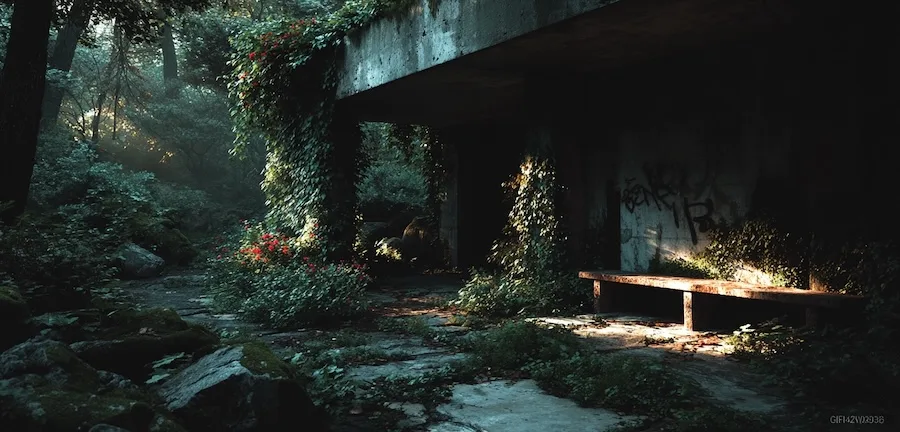
I also think AI image generation is mostly a plagiarism engine with a subscription model. Both things are true, and I’m not going to pretend the irony is lost on me.
Here’s the actual situation: the models were trained on work that wasn’t offered. Millions of images from artists who never consented, never got paid, never got credit. The zaibatsus — Midjourney, Adobe, OpenAI — own the weights now. You’re a tenant in a building constructed from other people’s walls.
The output reflects this. Most of what gets generated is visual junk food: stock photo replacements, marketing slop, fantasy porn, fake politicians. The aesthetic vocabulary of a century of human visual culture, compressed into a probability distribution and rented back to you at $20/month.
The technology is genuinely impressive and mostly being used for garbage. That’s not a contradiction — it’s just what happens when you hand powerful tools to a market optimizing for volume.
So why do I use it?
Because the tool and what you aim it at are different things. The models are blenders. What you put in, what you’re trying to make, what aesthetic decisions you bring — that’s still entirely on you. The blender doesn’t have taste. You either do or you don’t.
Most people using these tools are prompt-jockeying toward whatever gets engagement. That’s the aesthetic move: outsource the vision, keep the clicks. It produces the visual equivalent of a cover band — technically competent, spiritually empty.
The interesting question isn’t whether to use the tools. It’s whether you have anything to say with them.
The structural injustice is real and unsolved. The artists who fed the training data got nothing. That debt exists regardless of what you make with the output.
The Invisibility That Held gives this absorption a history: translators and security researchers also disappear into the artifact once their contribution has been incorporated, leaving the owner with the finished work and the contributor with nothing left to point at.
But opting out doesn’t fix the injustice. It just means someone with less to say fills the gap.
Update — 27 October 2026
The law has started separating questions that this piece compressed into one. In 2025, two federal courts treated model training as potentially fair use, but stressed different limits: lawful acquisition mattered in the Anthropic ruling, while market harm remained central in the Meta ruling. For image models, Andersen v. Stability AI still has no merits decision. The docket was active as recently as 26 October 2026, with the case still working through discovery disputes. (Reuters; CourtListener)
So the legal picture is no longer simply “nobody has decided.” Courts are beginning to distinguish lawful acquisition from piracy, training from output, and abstract competition from demonstrable market harm. None of that pays an artist whose work entered a dataset without consent. It does make the route from that debt to a legal remedy much less direct than the moral claim.
This piece was written with AI assistance. Everything I can, I do with AI assistance.